Saturday, July 11, 2015

The Definition of Homeless

Homeless.

What is the first thing that comes to mind when you see the word? A drunkard? A panhandler? A swindler? A substance abuser? A lazy fool? An unkempt societal plague?

Many people have ill conceived, disappointing, and quiet honestly, sinful, perceptions of what it means to be homeless. The definition of what it means to be homeless is in the very word itself:

If you do not have a place to call home then you are homeless.

There is a difference between being houseless and homeless. A house is a physical structure. A house provides shelter from the cold, the rain, the snow, and the wind. A house can be opened up to welcome in family and friends or shut up to exclude criminals and enemies. A house can be built or torn down and then rebuilt because it is a physical place.

Over the past few years in Colorado, there have been several destructive forest fires and terrible thunderstorms that caused massive flooding. Thousands of people were displaced from their houses. The fires consumed hundreds of structures and the floods destroyed hundreds more. However, Colorado's homeless numbers didn't drastically surge during this period. Despite being houseless, many families still had a place to call home. Their home wasn't defined by the physical walls and roof that surrounded them but it was defined by the family unit's love for each other, their determination to overcome tragedy together, and their ability to draw closer to each other during this time of struggle, want, and reconstruction.

Their is a stark contrast between being homeless and houseless. By pointing it out to you I hope that I can maybe start to re-paint an ugly picture that your thoughtless and impressionable mind and heart have allowed our materialistic culture to create within you.

Let me start out with the background. The background is usually dark and bleak. The portrait of a homeless person typically starts off with a canvas of a much darker hue than most people's. The environment is filled with hostility and animosity. Parents that are physically and verbally abusive. Pedophiles and molesters. Drug dealers and gang members. Domestic violence and murder. This is no Bob Ross painting. There are no fluffy clouds or happy trees with their happy tree friends here. The landscape is desolate, destroyed, scorched, and devastated. The trees lie torched by firestorm after firestorm and the rocks that cover the landscape have a thick layer of soot on them.

Many homeless people don't have a home and they never have. Since they were young children they've never had a place to call home. They may or may not have grown up in a house or apartment, but this place wasn't home to them. For some it was a torture chamber and for others it was a dungeon. This place housed them, their few belongings, and their tormentors. They couldn't stand the place, and they knew that any other place in the world had to be better than their house. Many of them made a dangerous and sometimes a courageous decision to risk life on the streets rather than housed under the roof of their greatest enemy.

Other homeless people's backgrounds aren't as dark. They start off with a beautiful canvas covered with every color of the palette in every shape and shade. They grew up in a house, a beautiful home, surrounded by people that loved them, cherished them, and called them family. They were homeful. However, disaster struck. Something turned their homeful life upside down, inside out, and discombobulated it in every way. Rape, molestation, domestic violence, abuse, drugs, alcohol, human trafficking, infidelity, death of a loved one, tragedy, war, unemployment, or coming out to their family. Tragedy forcefully dismantled their emotional home. The family they loved was lost or disowned them. Their friends grew few and less supportive. They had no one to turn to. No one to trust. No one to believe. They had no one.

This is the portrait of homelessness. Notice that the portrait of the person doesn't matter at all. It is the background. It is the environment that defines homelessness. A homeless person never ceases being a person. Their portrait resembles yours and mine down to every blemish, wrinkle, hair, feature, and facet. There is nothing about their essence that separates them from you and me.

What might happen if a homeless person was given a place to call home? What if they had a place to go when they were scared, tired, or at their wits end and were welcomed home with arms wide open and accepted by a warm, firm embrace? Isn't that what most of us appreciate most about our home? Is it not the fact that no matter how hard our weekdays, workdays, schooldays, and holidays are we have somewhere we can be surrounded by the people we love, the people that love us and accept us for just who we are, both the good and the bad? That's home.

If you give a homeless person a house you have not cured what ails them. If you give a homeless person a twenty dollar bill you are not helping cure what plagues them. If you give a homeless person a meal from McDonald's you shouldn't pat yourself on the back for doing your good deed for the year because you haven't accomplished much of anything.

"'For I was hungry and you gave me no food, I was thirsty and you gave me no drink, I was a stranger and you did not welcome me, naked and you did not clothe me, sick and in prison and you did not visit me.’ Then they also will answer, saying, ‘Lord, when did we see you hungry or thirsty or a stranger or naked or sick or in prison, and did not minister to you?’ Then he will answer them, saying, ‘Truly, I say to you, as you did not do it to one of the least of these, you did not do it to me.’"
(Matthew 25:42-45 ESV)

I know of a place that should be full of people that desire to give food to the food-less, drink to the drink-less, clothes to the clothes-less, hope to the hopeless, and homes to the homeless. However, this place is struggling with an infestation of materialistic, worldly minded, prideful, ungrateful, and lazy people who have turned their ears from their Lord and have allowed others to tickle their ears and their egos. These people call themselves Christians but there is nothing about their lives, behavior, or faith that resembles the Christ they claim to follow.

I do not desire to point the finger at others, but rather, I will be the first to admit that my view and my response to homelessness needs drastic reformation. In the neighborhood that I live in I'm only about a mile away from our city's largest concentration of homeless citizens. The opportunities abound. My neighborhood is literally an oasis amidst a community of homeless transients. Ironically, a mile away in the other direction is arguably one of the richest and most opulent neighborhoods in all of America: the Broadmoor. I go a mile north or east and I am surrounded by homelessness and I go a mile in the other directions and I am surrounded by mansions, million dollar estates, and a less known side of homelessness.

I do not venture into the Broadmoor area often, but rather, I frequently travel to the Walmart that falls almost in the center of this homeless community and my workplace, a human services non-profit that serves the homeless, impoverished, and addicted in our community. I am surrounded by homelessness and my job is to use my talents and skills to benefit a ministry that seeks to give the homeless a home. In the year and a half that I have worked at this ministry I have grown more and more ashamed of my Christian walk and that of 99% of the Christian and human population of Colorado Springs.

Our culture views homelessness as a plague and problem that is somebody else's problem. Our culture in America is up in arms about equal rights, fair treatment of minorities, and justice for every citizen. I watch the outcries on the news and see the social media protests of friends and family members every day. Civil rights, gay rights, women's rights and justice for the underdog. They protest outside the civil centers, they parade their rights down main street, and yet, none of these individuals or groups see the pain, frustration, abuse, and dehumanization of the homeless population of America. The homeless people are outside the civil centers every day and they parade down main street several times during the day asking for help and attention, and yet, nobody picks up their banner along with them.

Christians in this city, myself included, don't really know what to do when a homeless person approaches them and asks them for help. We're instantly skeptical of anyone asking us for money, we quickly discredit their story or need, and we find some excuse to escape their presence. On the other hand, some of us pride ourselves with our care and compassion for the poor by giving them some money and saying, "God bless you." Or perhaps we think we have outsmarted them by buying them a meal rather than giving them money for food or filling up their gas tank rather than giving them money for gas. All of these approaches, however, are not helpful responses to homelessness.

Maybe you think that I'm coming down too hard on Christians in my city and around the country. If so, then I challenge you with these questions:
  • Does your church have a homeless ministry?
  • Does your church support a local homeless ministry?
  • How many people participate in this ministry?
  • How often do you participate in this ministry?
  • How much of your church's annual budget is ear marked for homeless ministry (either running one or supporting one)?
I continually read articles and listen to Christians lament the perpetual decline of the faith and Christianity in this country. They blame it on the government, society, other Christian denominations, and everyone else than themselves. This next statement will hit the reformed and orthodox churches hardest: Faith without works is DEAD! As Christians, we can pride ourselves in our knowledge of God, our understanding of doctrine (especially reformed doctrine), and yet, if we are not out there putting our faith to practice then what good is a bunch of head knowledge. The reformers would be ashamed if they saw the churches that call themselves reformed these days. Reformed churches of the past were filled with the poor, the helpless, the hungry, the thirsty, the weak, the widows, the orphans, and the homeless of the world. Reformed churches of the present are filled with books and people that read them. The books are not bad. Rather, they are actually full of very truthful and practical applications of the Christian faith written by men and women who practiced them. Sadly, few who read them feel led to practice the contents as much as they argue with others who disagree with the contents.

Homeless people need a home. Homeless people need to know that they have a home. Homeless people need to know they have a family that loves them. Homeless people need to know that they have a Father that loves them despite their past sins and the past sins that were inflicted upon them. Homeless people need to know that there is a home waiting for them filled with people just like them that needed a place to call home. Homeless people need to know that the Christian Church is the perpetual home to the homeless. After all, the Church is Christ's home and those whom He welcomes into His family He will never forsake, cast out, or allow them to be homeless ever again for He sacrificed Himself to secure them within the household of God forever and forevermore.

Perhaps you are not a Christian and you find it offensive that I would say that the Christian Church ought to be the home for the homeless. However, the last time I checked, Christian ministries are the only ones seeking to care for the impoverished and homeless. Secular homeless shelters and ministries are near non-existent. As much as you despise Christians for their political views of equality, you ought to be completely heartbroken and ashamed that you fight for equal rights, justice, and freedom for every minority EXCEPT the homeless, arguably the most despised, mistreated, and dehumanized minority of them all. Sadly, if the secular agenda of this generation continues to make it harder and harder for Christian ministries to serve the homeless in this country with the Gospel (what the secular world refers to proselytizing) the worse and worse the problem of homelessness will grow. The secular world doesn't have an answer to the homeless soul looking for a home. They will throw money, food, clothes, and houses at them, not realizing that they need something money cannot buy, food cannot fulfill, clothes cannot cover, and houses cannot build: a place to call home.

 I cannot tell you what you and I do from here. Like I said, I'm feeling more and more ashamed of my view of the homeless and my lack of a ministry to them. How do we care for and provide a home for the homeless? That should be the headline of newspapers tomorrow. That should be the overlay of every Facebook profile picture tomorrow. That should be the topic for tomorrow's prayer time. That should be the conversation around the dinner table tonight. That should be on the top of the church's priority list, but it will take more than me writing this and you reading this to change that. We actually have to put our faith to work. We actually have to take a risk, do something we don't know much about, and travel into uncharted territory. I can think of no better home for a homeless person than the church of Jesus Christ.

How will you make your church a home for the homeless?


Saturday, January 31, 2015

Drowning


Lashing out in every direction, cursing the very air I breathe. Thrashing the air that surrounds me in a futile effort to keep it away from me. Enough! Enough! I have had my fill. I am drowning in this life. It is not the waters of the sea that fill my lungs, but rather, it is incessant air. Breath after breath, it fills me. I try to stop breathing but my will is not strong enough. Is it the body that betrays me by breathing or is it the breath of life that continually forces its way into me? It sustains me, and yet, I am tortured by it.

If tears were sweet would we not feast upon them and savor their every treat? However, tears are bitter and as unsavory as the waters that fill the oceans to the brim. To taste tears day and night is to drown in the ocean. Wave after wave pours over me. My diet consists of tears and sorrow. Tears, sorrow, and yet an immense hope. An undeniable hope.

I am drowning in a sea of sorrow, and I cannot go under. I have tried, but despite the waters flowing into my lungs, air pierces me deeply, forcing me to spit out the water. The air keeps me elevated over breaker after breaker. This is not perseverance. I have stopped kicking. I have tried letting go of hope, but it will not let go of me. This is preservation. I am being preserved by something far more powerful than my restless and downtrodden heart. It has stopped beating, but someone keeps pricking it back to life.

I looked around me, and I am not alone. There are many souls in this deluge of depression. The storm rages on and the waves secure victim after victim. To my left and to my right, I am surrounded on every side with people drowning. Some of them cry out horrifically for help. Their cries for help would haunt my dreams if only I had any to haunt. Others, however, battle to keep their head above water for a short while before they sink beneath the dark waters. They don't say a word. They slowly drift down into the abyss. They give up and something allows them to. However, I am yet sustained and preserved.

"Look at me."

There is a faint voice, but it sounds like it is too far in the distance to be of any help or hope. It speaks truth, I hear it clearly, but I know it must be far in the distance. There cannot be any hope in this ocean of turmoil. The voice is clear, crisp, powerful, and frightening. A cold chill travels over me, and yet a profound confidence and faith causes me to frantically search for the Words that I hear.

I kick and scream, and the more that I scream the more water enters into my lungs. The salt water stings as it forces its one into my mouth, down my throat, into my belly, into my essence, and I am tired of gagging up the putrid solution that stirs within me.

At times I begin to drift away. I slowly sink beneath the torrential rains and the hammering waves. It is peaceful beneath the waves, beneath the storm. It is quiet. There are no more screams for help. The raging, crashing, thunderous noise is muffled into a distant hum. It is here that I try to let go, but it is here that I am pricked with dissatisfaction and contempt with the idea of fading away. It is here that I am pushed back up to the surface and forced to once again drown.

Things were not always like this. I was once in the security of a ship that sailed upon these waters. Despite the raging of the storm, I had safety and security on the boat. The buoyancy of the vessel was not a sure hope, but it consistently elevated me above the waves. It required no faith or belief on my part to weather the storm. I knew the ship would only survive the waves for a time, that it could easily by crippled by the storm, that it would eventually sink below but it was much easier to cling to the boat than the undulating waves. The boat was solid. The boat was tangible. It was real.

And yet, I heard a voice call from the storm. "Come to me." It called for me, and I responded. Without knowing what in the world I was doing, I was climbing out of the ship into the storm. It made no sense to me, but I followed the calling voice. I took a few steps out of the ship and you wouldn't believe me if I told you, but I was truly walking above the waves. The voice kept calling. "Come!" I heard the voice, I listened to the voice, and I trusted the voice. My confidence was not my own but solely in the one calling me. The storm raged on around me. The walk was turbulent. At moments I stood on the peaks of waves and at others I was standing in the midst of an immense trough. Nevertheless, I kept hearing the voice calling and I continued to obey.

However, I began to look around me and noticed that I was not walking out of the storm but into the heart of it. The waves were growing larger and they were crashing over me harder and harder. Although I was above the sea below, the waters still washed over me, disheartening me. I began to fear that I would not be able to stay above the waters for much longer. The more and more I began to lose confidence in my ability to follow the voice calling, I began to sink deeper and deeper into the frigid, turbulent grasp of death.

I panicked, and I was no longer suspended over the sea but drowning in it. I started swinging my arms frantically, kicking my legs unceasingly, and grasping for breath but to no avail. The waves felt more and more like hands trying to push me into the darkness beneath. I felt caught in an unnatural tug-of-war between the darkness below and the air above. It is not drowning that will kill you. You are dead when you stop drowning, when you stop gasping for breath, and when you have nothing left to breath but the salty waters that surround you. Drowning, on the other hand, is a losing battle as the waters below seek to keep the breath out of your lungs long enough for you to succumb to their will. My lungs filled with as much water as air, perhaps more water than air, but never enough to end the battle. I longed for the moment when the waves would subdue me once for all, but that moment was never realized.

I grew tired of drowning. I grew tired of resting on the cusp of life and death. I gave up and I gave in. I was tired of fighting. I was exhausted.

"Look at me."

The voice was very close this time. It sounded like it was right on top of me. I heard it clearly. I heard it as clearly as I hear my own thoughts. It was as if the voice resided and emanated from within me. I looked up, and there He was.

"Lord, save me"

Immediately, a hand reached out and plucked me up out of the water like a brand from the fire.

    Why are you cast down, O my soul,
        and why are you in turmoil within me?
    Hope in God; for I shall again praise him,
        my salvation and my God.

(Psalm 42:11 ESV)

But you must remember, beloved, the predictions of the apostles of our Lord Jesus Christ. They said to you, “In the last time there will be scoffers, following their own ungodly passions.” It is these who cause divisions, worldly people, devoid of the Spirit. But you, beloved, building yourselves up in your most holy faith and praying in the Holy Spirit, keep yourselves in the love of God, waiting for the mercy of our Lord Jesus Christ that leads to eternal life. And have mercy on those who doubt; save others by snatching them out of the fire; to others show mercy with fear, hating even the garment stained by the flesh.
(Jude 1:17-23 ESV)


Saturday, December 13, 2014

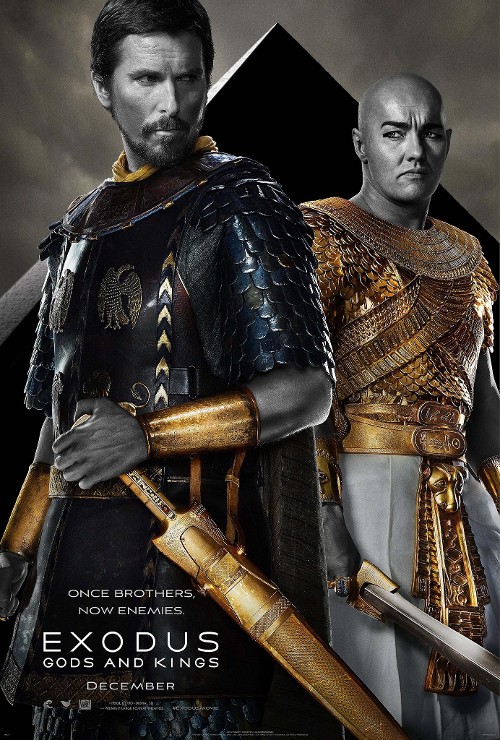
Exodus: Gods and Kings...and Children?


First of all, I have to be honest. Despite much of the skepticism surrounding the newly released Exodus: Gods and Kings, I truly believed that Ridley Scott was going to accomplish something that many other directors failed to accomplish when making film adaptations of biblical history. I expected this masterful filmmaker to turn the tide of Hollywood's gross and negligent treatment of the history of the world contained in holy Scripture. Ridley Scott was, without a doubt, my favorite director before I saw this film. I'm a huge fan of historical fiction that takes place in ancient and medieval eras. Scott has a knack for bringing history to life with his movies. With a wonderful resume' that includes Gladiator, Kingdom of Heaven, and Robin Hood, I had high expectations for Exodus. My expectations were sadly dashed 15 seconds into the film. It starts with a sad and pathetic:

1300 BCE

This set the tone for the entire rest of the film. For those of you who are not familiar with the acronym BCE, it stands for Before the Common Era and is a modern effort to reframe history so that Christ Jesus is not the central figure of human history. Despite replacing "Before Christ," however, the timetable remains exactly the same. 1300 BCE is the same year 1300 BC (Before Christ). It's just a way to make liberal historians less offended that Christ is still the central figure throughout human history and nothing they do will ever change that.

As a film, I have no problems with Exodus except for a few terrible casting decisions (one of the Egyptians was trying really hard to cover up his Scottish accent). It's visually stunning, the characters (and they are characters) are as developed as a two hour film can really allow, and Scott presents the historical story in a way that makes the history come alive.

The biggest problem with the film, however, is that this is not Scott's story to tell any way he wants to.

When Peter Jackson took The Hobbit and Hollywoodized it into a nine hour, epic re-imagining of Tolkien's literature, there was some push back from diehard Tolkien fans. There were some hurt feelings, people wrote the movies off as another expensive money grab effort from Hollywood, some people have bore through watching the tiresome films try to recreate the magic of the Lord of the Rings trilogy (which has washed off a long time ago), and for the most part, Hollywood just made some fantasy nerds mad.

Ridley Scott, however, decided to join the ranks of many of Hollywood's most deplorable agents by treating Scripture like The Hobbit. You can re-imagine literature all you want, and the audience will be the judge of whether or not your rendition of the story is worthy or not by buying or not buying a ticket. However, you cannot re-write history so haphazardly and expect an intelligent, scholarly, and resilient faith community to stand by, shrug their shoulders, and watch as you make us out to be incredibly ignorant foolhardy nut cases who will believe just about anything.

I'm going to spoil the movie for you: the Israelites make it out of Egypt after crossing the Red Sea. It is all thanks to their heavenly child god.

No, you read that correctly. Child god.

The movie started out somewhat promising despite the glamorization of Moses and Ramases' relationship. It was like a live-action version of The Prince of Egypt at first, portraying Moses and Ramases as good friends who grew up together as if they were family. Although they are cousins, their bond is fraternal. Scott deviates from the biblical record quite grievously several times before his biggest mistake, and the next thing you know, Moses meets Zipporah, climbs up "God's mountain" chasing after some sheep, gets caught in a mud slide that breaks his leg, and wakes up to find a young boy stacking rocks in the shape of a pyramid. Just for the record, though, there is a burning bush in the background.

I don't expect Hollywood to follow the biblical account exactly. However, this is a very blasphemous deviation from the historic record. For the rest of the film, Egypt is represented by a strong, caring, loving father who is devastated when he and the rest of Egypt awake to find their firstborn children dead and Israel is represented by a unintelligent, and uncaring mob and a schizophrenic who abandons his family to follow the whims of a blood-thirsty, vengeful, and immature child who is supposed to represent the creator of heaven and earth. I feel very confident, that despite the blatant mockery of the the Christian faith (and the Jewish faith as well), most people who are ignorant of the biblical record still know that Christians and Jews do not pray to their child who art in heaven. Who do they think they are fooling?

From a business perspective, I am once again floored and confused by production companies making film adaptations of biblical stories and then alienating the only audience that has any invested interest in viewing the film. Atheists could care less about a movie about what they view as a make-believe fairytale. They'll see it once, wag their heads at the Christian community for believing any of that nonsense is true, and then they'll go on their merry way. Christian film is big business, and I know because I'm tired of watching all of the nauseating, poorly done ones that receive five stars on Netflix just because it's "Christian" and the main character has values. I don't understand why Hollywood hasn't caught on that, if they put their agenda to the side and stick to the biblical record, they can make buku bucks on a generation of Christians who are dying to see their faith accurately portrayed on the big screen. There is a generation of Christians out there that want their faith to be legitimized and taken seriously by an artistic community that continuously portrays them as nut cases who believe in rock people that saved Noah and now an oddball that left his family to follow a young boy who can stack rocks (I'm seeing a theme with the rocks).

The film was extremely confusing to me. I couldn't wrap my head around the message behind the film. On one hand, Scott decimates any and all influence that the Exodus has on the Christian and Jewish faith communities by detracting Israel or Moses' faith in God from the story completely. The only people in the movie with faith are Zipporah and a witch doctor. The Hebrews are not resting in God's promises, Moses spends most of his lines ridiculing the imaginary boy god for being a vengeful brat, and the Passover is all about pitying the poor lambs (boohoo). And yet, Scott doesn't shy away from presenting the story as a historic event that took place in a historic place and time with historic people. What's more, he also portrays the plagues as supernatural (albeit somewhat natural chain of) events. At first, the Nile turns into blood because ships of fishermen are attacked by blood-thirsty crocodiles, but Scott portrays every drop of water in Egypt eventually turning to blood and killing all of the crops and fish. He didn't clearly demonstrate that the plagues only affected the Egyptians, but by this point in the move, I was used to disappointment.

Overall, the message was mixed and confused. Quite honestly, I felt like I was watching a film made by a man who doesn't believe an iota of the biblical record as historical but cannot understand how billions of people around the world today and throughout history have not only believed that the Exodus is true, but point to it as a crucial part of their faith in God. It's a film by a man who quickly realized that he bit off far more than he could swallow, regretted making the film, but finished it because he had to. The first ending credit was, "For Tony Scott" (Ridley's older brother who committed suicide a few years ago). I feel like this is a film made by a man who is desperately wrestling with the reality of God, death, eternity, and faith, is struggling to understand his brother's suicide and reasoning behind it and made this film throughout his grieving process.

As Christians, we expect film adaptations of biblical history to be accurate through and through. There is no place for the artist in these films. However, film making isn't always about the story as much as it is about the filmmaker. This film clearly abandoned all reason and fidelity to the faith communities who were hoping it would turn the tide in Hollywood. However, taking a step back after seeing it, there are a couple of things to be observed from the artistic license Ridley Scott took with this story.

First of all, Scott portrays God as a mere, pathetic, immature, boyish child. This could be an allegory of Scott's personal struggles with the living God that has recently culminated in the difficult reality of the finity of life demonstrated by the abrupt death of his beloved brother. He portrays God as a fickle boy who just wants to see the people who bullied His people suffer and endure hardship. There's no glimpse into God's love, wisdom, sovereignty, authority, promises, faithfulness, and grace. Rather, God just wants pay pack. I wonder why Scott thinks God called Moses in the first place, since Scott basically has God challenge Moses and then do it himself after he sees how pathetic Moses is in his rendition of the story. This is clearly a film made by a filmmaker who is wrestling with God, and is struggling with balancing his worldview with the truth that he suppresses. This clearly comes out in the film, and Christians who see the film should recognize that the director of the film clearly has some battles taking place in his life.

Additionally, I found it somewhat ironic that this film portrays God as a child (quite blasphemously) during the time of year where the broader Christian church exalts baby Jesus (quite blasphemously). I would actually like to have a conversation with someone who is a die-hard "Jesus is the reason for the season" Christmas celebrator to explain why they find it offensive when Scott portrays God as a boy while they don't think it is offensive at all to exalt baby Jesus as "the reason for the season." When Jesus was born, He was fully God and fully man. God took our flesh, and at one very real point in history, He was a humble, nursing, weak, fragile, helpless, baby boy. However, even at this point, He was still God and the wise men traveled thousands of miles to worship Him as God. However, the way many Christians can speak about "baby Jesus" is not revering, not honoring to God, and is blasphemous towards the attributes of God. Jesus was a baby, and therefore, in His human nature He was vulnerable and as weak as a newborn babe. However, Jesus was still completely God, possessing every immutable attribute of God at that same time. That has to be balanced this time of year, as many people want to exalt a baby over and above almighty God.

In conclusion, Exodus: Gods and Kings is a major letdown. I had high expectations of Ridley Scott, and he made another blasphemous film adaptation of biblical history. I saw the movie, and I can save you the money of seeing it in theaters. However, as Christians, I think these films are not complete wastes of time. If you wanted to see if for the legitimization of what you believe, then yeah, you should probably skip it because it's going to hurt your feelings that, yet again, the world portrays the object of your faith as nothing but a foolhardy fairy tale. On the other hand, if you want to be objective and critical of the film's portrayal of what you believe, then it might just be worth renting at Redbox. It is a great insight into the eyes and minds of the nay sayers. Honestly, it's a strawman argument wrapped up in filmmaking clothing. It just comes to show that the world is not yet ready to take us seriously, and cannot accurately portray our argument (faith) before they tear it down. Don't be offended, but rather, use it as fuel to set the world ablaze by setting the record straight. Our faith, albeit foolishness to the world, is truth to those who have eyes to see and ears to hear.  

For the word of the cross is folly to those who are perishing, but to us who are being saved it is the power of God. For it is written,

    “I will destroy the wisdom of the wise,
        and the discernment of the discerning I will thwart.”
  
        Where is the one who is wise? Where is the scribe? Where is the debater of this age? Has not God made foolish the wisdom of the world? For since, in the wisdom of God, the world did not know God through wisdom, it pleased God through the folly of what we preach to save those who believe. For Jews demand signs and Greeks seek wisdom, but we preach Christ crucified, a stumbling block to Jews and folly to Gentiles, but to those who are called, both Jews and Greeks, Christ the power of God and the wisdom of God. For the foolishness of God is wiser than men, and the weakness of God is stronger than men.

    For consider your calling, brothers: not many of you were wise according to worldly standards, not many were powerful, not many were of noble birth. But God chose what is foolish in the world to shame the wise; God chose what is weak in the world to shame the strong; God chose what is low and despised in the world, even things that are not, to bring to nothing things that are, so that no human being might boast in the presence of God. And because of him you are in Christ Jesus, who became to us wisdom from God, righteousness and sanctification and redemption, so that, as it is written, “Let the one who boasts, boast in the Lord.”


(1 Corinthians 1:18-31 ESV)