Saturday, January 31, 2015

Drowning


Lashing out in every direction, cursing the very air I breathe. Thrashing the air that surrounds me in a futile effort to keep it away from me. Enough! Enough! I have had my fill. I am drowning in this life. It is not the waters of the sea that fill my lungs, but rather, it is incessant air. Breath after breath, it fills me. I try to stop breathing but my will is not strong enough. Is it the body that betrays me by breathing or is it the breath of life that continually forces its way into me? It sustains me, and yet, I am tortured by it.

If tears were sweet would we not feast upon them and savor their every treat? However, tears are bitter and as unsavory as the waters that fill the oceans to the brim. To taste tears day and night is to drown in the ocean. Wave after wave pours over me. My diet consists of tears and sorrow. Tears, sorrow, and yet an immense hope. An undeniable hope.

I am drowning in a sea of sorrow, and I cannot go under. I have tried, but despite the waters flowing into my lungs, air pierces me deeply, forcing me to spit out the water. The air keeps me elevated over breaker after breaker. This is not perseverance. I have stopped kicking. I have tried letting go of hope, but it will not let go of me. This is preservation. I am being preserved by something far more powerful than my restless and downtrodden heart. It has stopped beating, but someone keeps pricking it back to life.

I looked around me, and I am not alone. There are many souls in this deluge of depression. The storm rages on and the waves secure victim after victim. To my left and to my right, I am surrounded on every side with people drowning. Some of them cry out horrifically for help. Their cries for help would haunt my dreams if only I had any to haunt. Others, however, battle to keep their head above water for a short while before they sink beneath the dark waters. They don't say a word. They slowly drift down into the abyss. They give up and something allows them to. However, I am yet sustained and preserved.

"Look at me."

There is a faint voice, but it sounds like it is too far in the distance to be of any help or hope. It speaks truth, I hear it clearly, but I know it must be far in the distance. There cannot be any hope in this ocean of turmoil. The voice is clear, crisp, powerful, and frightening. A cold chill travels over me, and yet a profound confidence and faith causes me to frantically search for the Words that I hear.

I kick and scream, and the more that I scream the more water enters into my lungs. The salt water stings as it forces its one into my mouth, down my throat, into my belly, into my essence, and I am tired of gagging up the putrid solution that stirs within me.

At times I begin to drift away. I slowly sink beneath the torrential rains and the hammering waves. It is peaceful beneath the waves, beneath the storm. It is quiet. There are no more screams for help. The raging, crashing, thunderous noise is muffled into a distant hum. It is here that I try to let go, but it is here that I am pricked with dissatisfaction and contempt with the idea of fading away. It is here that I am pushed back up to the surface and forced to once again drown.

Things were not always like this. I was once in the security of a ship that sailed upon these waters. Despite the raging of the storm, I had safety and security on the boat. The buoyancy of the vessel was not a sure hope, but it consistently elevated me above the waves. It required no faith or belief on my part to weather the storm. I knew the ship would only survive the waves for a time, that it could easily by crippled by the storm, that it would eventually sink below but it was much easier to cling to the boat than the undulating waves. The boat was solid. The boat was tangible. It was real.

And yet, I heard a voice call from the storm. "Come to me." It called for me, and I responded. Without knowing what in the world I was doing, I was climbing out of the ship into the storm. It made no sense to me, but I followed the calling voice. I took a few steps out of the ship and you wouldn't believe me if I told you, but I was truly walking above the waves. The voice kept calling. "Come!" I heard the voice, I listened to the voice, and I trusted the voice. My confidence was not my own but solely in the one calling me. The storm raged on around me. The walk was turbulent. At moments I stood on the peaks of waves and at others I was standing in the midst of an immense trough. Nevertheless, I kept hearing the voice calling and I continued to obey.

However, I began to look around me and noticed that I was not walking out of the storm but into the heart of it. The waves were growing larger and they were crashing over me harder and harder. Although I was above the sea below, the waters still washed over me, disheartening me. I began to fear that I would not be able to stay above the waters for much longer. The more and more I began to lose confidence in my ability to follow the voice calling, I began to sink deeper and deeper into the frigid, turbulent grasp of death.

I panicked, and I was no longer suspended over the sea but drowning in it. I started swinging my arms frantically, kicking my legs unceasingly, and grasping for breath but to no avail. The waves felt more and more like hands trying to push me into the darkness beneath. I felt caught in an unnatural tug-of-war between the darkness below and the air above. It is not drowning that will kill you. You are dead when you stop drowning, when you stop gasping for breath, and when you have nothing left to breath but the salty waters that surround you. Drowning, on the other hand, is a losing battle as the waters below seek to keep the breath out of your lungs long enough for you to succumb to their will. My lungs filled with as much water as air, perhaps more water than air, but never enough to end the battle. I longed for the moment when the waves would subdue me once for all, but that moment was never realized.

I grew tired of drowning. I grew tired of resting on the cusp of life and death. I gave up and I gave in. I was tired of fighting. I was exhausted.

"Look at me."

The voice was very close this time. It sounded like it was right on top of me. I heard it clearly. I heard it as clearly as I hear my own thoughts. It was as if the voice resided and emanated from within me. I looked up, and there He was.

"Lord, save me"

Immediately, a hand reached out and plucked me up out of the water like a brand from the fire.

    Why are you cast down, O my soul,
        and why are you in turmoil within me?
    Hope in God; for I shall again praise him,
        my salvation and my God.

(Psalm 42:11 ESV)

But you must remember, beloved, the predictions of the apostles of our Lord Jesus Christ. They said to you, “In the last time there will be scoffers, following their own ungodly passions.” It is these who cause divisions, worldly people, devoid of the Spirit. But you, beloved, building yourselves up in your most holy faith and praying in the Holy Spirit, keep yourselves in the love of God, waiting for the mercy of our Lord Jesus Christ that leads to eternal life. And have mercy on those who doubt; save others by snatching them out of the fire; to others show mercy with fear, hating even the garment stained by the flesh.
(Jude 1:17-23 ESV)

Saturday, December 13, 2014

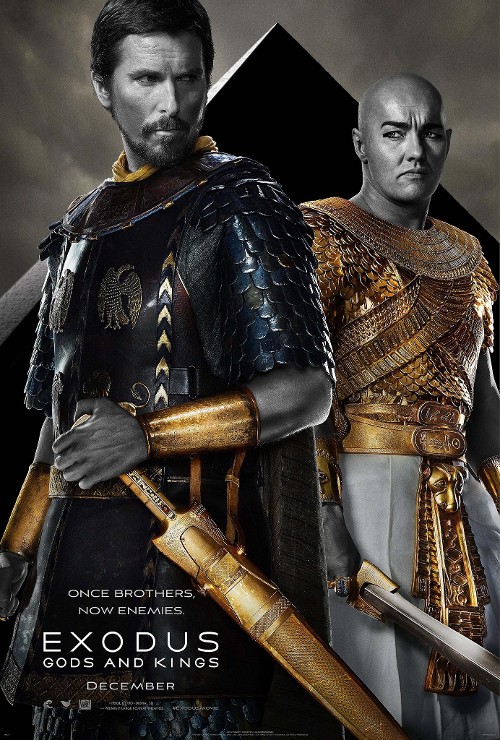
Exodus: Gods and Kings...and Children?


First of all, I have to be honest. Despite much of the skepticism surrounding the newly released Exodus: Gods and Kings, I truly believed that Ridley Scott was going to accomplish something that many other directors failed to accomplish when making film adaptations of biblical history. I expected this masterful filmmaker to turn the tide of Hollywood's gross and negligent treatment of the history of the world contained in holy Scripture. Ridley Scott was, without a doubt, my favorite director before I saw this film. I'm a huge fan of historical fiction that takes place in ancient and medieval eras. Scott has a knack for bringing history to life with his movies. With a wonderful resume' that includes Gladiator, Kingdom of Heaven, and Robin Hood, I had high expectations for Exodus. My expectations were sadly dashed 15 seconds into the film. It starts with a sad and pathetic:

1300 BCE

This set the tone for the entire rest of the film. For those of you who are not familiar with the acronym BCE, it stands for Before the Common Era and is a modern effort to reframe history so that Christ Jesus is not the central figure of human history. Despite replacing "Before Christ," however, the timetable remains exactly the same. 1300 BCE is the same year 1300 BC (Before Christ). It's just a way to make liberal historians less offended that Christ is still the central figure throughout human history and nothing they do will ever change that.

As a film, I have no problems with Exodus except for a few terrible casting decisions (one of the Egyptians was trying really hard to cover up his Scottish accent). It's visually stunning, the characters (and they are characters) are as developed as a two hour film can really allow, and Scott presents the historical story in a way that makes the history come alive.

The biggest problem with the film, however, is that this is not Scott's story to tell any way he wants to.

When Peter Jackson took The Hobbit and Hollywoodized it into a nine hour, epic re-imagining of Tolkien's literature, there was some push back from diehard Tolkien fans. There were some hurt feelings, people wrote the movies off as another expensive money grab effort from Hollywood, some people have bore through watching the tiresome films try to recreate the magic of the Lord of the Rings trilogy (which has washed off a long time ago), and for the most part, Hollywood just made some fantasy nerds mad.

Ridley Scott, however, decided to join the ranks of many of Hollywood's most deplorable agents by treating Scripture like The Hobbit. You can re-imagine literature all you want, and the audience will be the judge of whether or not your rendition of the story is worthy or not by buying or not buying a ticket. However, you cannot re-write history so haphazardly and expect an intelligent, scholarly, and resilient faith community to stand by, shrug their shoulders, and watch as you make us out to be incredibly ignorant foolhardy nut cases who will believe just about anything.

I'm going to spoil the movie for you: the Israelites make it out of Egypt after crossing the Red Sea. It is all thanks to their heavenly child god.

No, you read that correctly. Child god.

The movie started out somewhat promising despite the glamorization of Moses and Ramases' relationship. It was like a live-action version of The Prince of Egypt at first, portraying Moses and Ramases as good friends who grew up together as if they were family. Although they are cousins, their bond is fraternal. Scott deviates from the biblical record quite grievously several times before his biggest mistake, and the next thing you know, Moses meets Zipporah, climbs up "God's mountain" chasing after some sheep, gets caught in a mud slide that breaks his leg, and wakes up to find a young boy stacking rocks in the shape of a pyramid. Just for the record, though, there is a burning bush in the background.

I don't expect Hollywood to follow the biblical account exactly. However, this is a very blasphemous deviation from the historic record. For the rest of the film, Egypt is represented by a strong, caring, loving father who is devastated when he and the rest of Egypt awake to find their firstborn children dead and Israel is represented by a unintelligent, and uncaring mob and a schizophrenic who abandons his family to follow the whims of a blood-thirsty, vengeful, and immature child who is supposed to represent the creator of heaven and earth. I feel very confident, that despite the blatant mockery of the the Christian faith (and the Jewish faith as well), most people who are ignorant of the biblical record still know that Christians and Jews do not pray to their child who art in heaven. Who do they think they are fooling?

From a business perspective, I am once again floored and confused by production companies making film adaptations of biblical stories and then alienating the only audience that has any invested interest in viewing the film. Atheists could care less about a movie about what they view as a make-believe fairytale. They'll see it once, wag their heads at the Christian community for believing any of that nonsense is true, and then they'll go on their merry way. Christian film is big business, and I know because I'm tired of watching all of the nauseating, poorly done ones that receive five stars on Netflix just because it's "Christian" and the main character has values. I don't understand why Hollywood hasn't caught on that, if they put their agenda to the side and stick to the biblical record, they can make buku bucks on a generation of Christians who are dying to see their faith accurately portrayed on the big screen. There is a generation of Christians out there that want their faith to be legitimized and taken seriously by an artistic community that continuously portrays them as nut cases who believe in rock people that saved Noah and now an oddball that left his family to follow a young boy who can stack rocks (I'm seeing a theme with the rocks).

The film was extremely confusing to me. I couldn't wrap my head around the message behind the film. On one hand, Scott decimates any and all influence that the Exodus has on the Christian and Jewish faith communities by detracting Israel or Moses' faith in God from the story completely. The only people in the movie with faith are Zipporah and a witch doctor. The Hebrews are not resting in God's promises, Moses spends most of his lines ridiculing the imaginary boy god for being a vengeful brat, and the Passover is all about pitying the poor lambs (boohoo). And yet, Scott doesn't shy away from presenting the story as a historic event that took place in a historic place and time with historic people. What's more, he also portrays the plagues as supernatural (albeit somewhat natural chain of) events. At first, the Nile turns into blood because ships of fishermen are attacked by blood-thirsty crocodiles, but Scott portrays every drop of water in Egypt eventually turning to blood and killing all of the crops and fish. He didn't clearly demonstrate that the plagues only affected the Egyptians, but by this point in the move, I was used to disappointment.

Overall, the message was mixed and confused. Quite honestly, I felt like I was watching a film made by a man who doesn't believe an iota of the biblical record as historical but cannot understand how billions of people around the world today and throughout history have not only believed that the Exodus is true, but point to it as a crucial part of their faith in God. It's a film by a man who quickly realized that he bit off far more than he could swallow, regretted making the film, but finished it because he had to. The first ending credit was, "For Tony Scott" (Ridley's older brother who committed suicide a few years ago). I feel like this is a film made by a man who is desperately wrestling with the reality of God, death, eternity, and faith, is struggling to understand his brother's suicide and reasoning behind it and made this film throughout his grieving process.

As Christians, we expect film adaptations of biblical history to be accurate through and through. There is no place for the artist in these films. However, film making isn't always about the story as much as it is about the filmmaker. This film clearly abandoned all reason and fidelity to the faith communities who were hoping it would turn the tide in Hollywood. However, taking a step back after seeing it, there are a couple of things to be observed from the artistic license Ridley Scott took with this story.

First of all, Scott portrays God as a mere, pathetic, immature, boyish child. This could be an allegory of Scott's personal struggles with the living God that has recently culminated in the difficult reality of the finity of life demonstrated by the abrupt death of his beloved brother. He portrays God as a fickle boy who just wants to see the people who bullied His people suffer and endure hardship. There's no glimpse into God's love, wisdom, sovereignty, authority, promises, faithfulness, and grace. Rather, God just wants pay pack. I wonder why Scott thinks God called Moses in the first place, since Scott basically has God challenge Moses and then do it himself after he sees how pathetic Moses is in his rendition of the story. This is clearly a film made by a filmmaker who is wrestling with God, and is struggling with balancing his worldview with the truth that he suppresses. This clearly comes out in the film, and Christians who see the film should recognize that the director of the film clearly has some battles taking place in his life.

Additionally, I found it somewhat ironic that this film portrays God as a child (quite blasphemously) during the time of year where the broader Christian church exalts baby Jesus (quite blasphemously). I would actually like to have a conversation with someone who is a die-hard "Jesus is the reason for the season" Christmas celebrator to explain why they find it offensive when Scott portrays God as a boy while they don't think it is offensive at all to exalt baby Jesus as "the reason for the season." When Jesus was born, He was fully God and fully man. God took our flesh, and at one very real point in history, He was a humble, nursing, weak, fragile, helpless, baby boy. However, even at this point, He was still God and the wise men traveled thousands of miles to worship Him as God. However, the way many Christians can speak about "baby Jesus" is not revering, not honoring to God, and is blasphemous towards the attributes of God. Jesus was a baby, and therefore, in His human nature He was vulnerable and as weak as a newborn babe. However, Jesus was still completely God, possessing every immutable attribute of God at that same time. That has to be balanced this time of year, as many people want to exalt a baby over and above almighty God.

In conclusion, Exodus: Gods and Kings is a major letdown. I had high expectations of Ridley Scott, and he made another blasphemous film adaptation of biblical history. I saw the movie, and I can save you the money of seeing it in theaters. However, as Christians, I think these films are not complete wastes of time. If you wanted to see if for the legitimization of what you believe, then yeah, you should probably skip it because it's going to hurt your feelings that, yet again, the world portrays the object of your faith as nothing but a foolhardy fairy tale. On the other hand, if you want to be objective and critical of the film's portrayal of what you believe, then it might just be worth renting at Redbox. It is a great insight into the eyes and minds of the nay sayers. Honestly, it's a strawman argument wrapped up in filmmaking clothing. It just comes to show that the world is not yet ready to take us seriously, and cannot accurately portray our argument (faith) before they tear it down. Don't be offended, but rather, use it as fuel to set the world ablaze by setting the record straight. Our faith, albeit foolishness to the world, is truth to those who have eyes to see and ears to hear.  

For the word of the cross is folly to those who are perishing, but to us who are being saved it is the power of God. For it is written,

    “I will destroy the wisdom of the wise,
        and the discernment of the discerning I will thwart.”
  
        Where is the one who is wise? Where is the scribe? Where is the debater of this age? Has not God made foolish the wisdom of the world? For since, in the wisdom of God, the world did not know God through wisdom, it pleased God through the folly of what we preach to save those who believe. For Jews demand signs and Greeks seek wisdom, but we preach Christ crucified, a stumbling block to Jews and folly to Gentiles, but to those who are called, both Jews and Greeks, Christ the power of God and the wisdom of God. For the foolishness of God is wiser than men, and the weakness of God is stronger than men.

    For consider your calling, brothers: not many of you were wise according to worldly standards, not many were powerful, not many were of noble birth. But God chose what is foolish in the world to shame the wise; God chose what is weak in the world to shame the strong; God chose what is low and despised in the world, even things that are not, to bring to nothing things that are, so that no human being might boast in the presence of God. And because of him you are in Christ Jesus, who became to us wisdom from God, righteousness and sanctification and redemption, so that, as it is written, “Let the one who boasts, boast in the Lord.”


(1 Corinthians 1:18-31 ESV)

Thursday, December 4, 2014

Racial DiscrimiNATION

Ferguson. A year ago, you'd never heard of it. You couldn't locate it on a map if you tried. Today, many of us still can't find it on the map, but we're bombarded from every direction about Ferguson, MO. I've loathed checking my Facebook news feed for several weeks now because everyone wants to share their opinion on this "polarizing" topic. It's a mixture of supposed police brutality coupled with racial profiling. It's a tough subject to stomach. Either you stand behind the "Hands Up! Don't Shoot" protests or, well, to put it bluntly, you're ignorant or racist.


Is it possible, however, that America is letting their emotions get to them and making a big deal about race when race isn't the underlying problem?

Let's play a little word association. I want you to think of the color that comes to mind when you see the following words:

Criminal.

Police officer.

Why did you think of the color you did? Was it because you're racist? I don't think so. I think it is because you're a keen observer. Before you think you know what I mean by that statement, hold on a second and keep reading. I'm sure you don't know where I'm coming from or headed.

Now, let's play the same word association game. This time, don't even try to escape racial profiling. What race comes to mind when you see the following words:

Terrorist
President
Politician
News Anchor
Basketball
Hockey
High school dropout
Doctor
Cartoon
Janitor
Model
Baptist
Presbyterian

Hmmm. That's interesting. A race immediately popped into your mind with each word. Why is that? Of course you thought of a Chinese terrorist, a Colombian president, a Cherokee politician, an Indian news anchor, a Western European basketball player, an African American hockey player, a Japanese high school dropout, and a female, red-haired Scottish doctor. No? What does that say about you as a person? Are you discriminating?

Where am I going with this? Well, let me demonstrate the very sad racial problem with America's response to Ferguson. You see, the very sad reality about America is that we are a country full of racial discriminators, and most of the racial discriminators don't even know that they're discriminating. The problem in America isn't that people with different colors of pigmentation are treated differently, but rather, that we're still seeing skin color and letting it affect our decisions and worldviews.

Point in case, is the problem in Ferguson that a black man was shot by a white man? If that is the underlying problem and the one that needs to be addressed throughout this nation, then we need to hold every man that shoots a person of a different ethnicity accountable for his actions. If a black man shoots a white man, then that needs to be addressed by a congressional committee. Or if a Hispanic man shoots an Asian man then that needs to be addressed with the same amount of outrage. However, that's not happening.

Shouldn't the real problem in Ferguson be that a police officer shot and killed an innocent man with his hands up (if that is what really happened)? Isn't that the real issue, here? How did this become about black and white? What made the citizens of Ferguson and America blow this problem out of proportion and make it a black and white racial issue?

I've grown up in Colorado Springs all of my life. The community that I grew up was a suburb filled with primarily white people. There were about a dozen black kids in my elementary school. One thing that separated them from me and the rest of my classmates was the color of their skin. But, as kids, we didn't really care. We didn't see the color of their skin as something that should cause us to treat them differently. It wasn't until adults started making a big deal of the disproportionate numbers of white and black kids in schools and the disproportionate amount of time that we focused on "white" history that us kids started to think that the color of skin should matter.

By the time I was in high school, things had progressed even further. It was a harsh reality to me and many of my classmates that our eligibility to attend certain colleges around the nation would be determined by the color of our skin and the college's quota for our skin color (something called affirmative action). What's more, we would all find it hard to stomach that our ability to pursue certain jobs in certain large corporations would be hindered by our skin color in an acceptable form of racial discrimination.

In my junior year of high school, I started to apply for jobs to pay for gas money and car insurance. Towards the end of every application, I was asked to check a box next to my ethnicity. The options were always disheartening to me:
  • Native American
  • Asian American
  • Hispanic American
  • African American
  • White
They never had a box for German/Polish/Scottish/English native American.What I found most amusing by this question on every job application is that there was always a little section of legal jargon before the question that stated that no hiring decisions would be determined by the color of my skin. And yet, the question is on every job application. Why is that? If it doesn't matter what color your skin is when applying for a job, then why ask the question? Racial discrimination?

Some things haven't changed since the 60s. We're still not color blind. Our country is still obsessed with discriminating color. Did you know that the definition of the word "discriminate" is simply: recognize a distinction; differentiate? There is a lot of racial discrimination in America these days. Most of it is by people pointing fingers at other people and calling them out on exactly what they're doing. A lot of people in this nation need to recognize the log in their own eyes before they start complaining about a speck in someone else's.

Criminal.

Police officer.

I want to revisit my statement that you probably thought black criminal and white police officer and that's because you're a keen observer. I didn't want you to jump to conclusions based upon that statement, but rather, I wanted you to hear me out. I said you were observant because the attention this story has garnered by the media is causing a form of brain washing on those who are not thinking critically about the story. When you listen to the radio talk shows (who does that?), watch the news stations, read the newspaper, and check out the blog postings posted on Facebook, you keep hearing and seeing black and white juxtaposed with the words criminal and police officer. The more and more you hear it, the more and more you let your guard down to discern the connection and/or disconnection between the two race words and the words they are attributed to. It's actually a form of propaganda and brain washing, and I'm watching more and more of my friends and family fall victim to the media's mind games.

Take a step back, now. Is the problem in Ferguson that a white man shot a black man? Or is the underlying problem in Ferguson that a police officer shot and killed an unarmed man and that there was little to no investigation into the officer's actions by the department and outside agencies? I really don't think it is both.

Does the color of these two men's skin really have a bearing in the problem? If a Hispanic officer in a predominately Hispanic police department shoots and kills an unarmed Asian man in a predominately Asian neighborhood and the department hardly investigates the officers actions is this country going to respond the same way? Would we have a racial problem that needs to be addressed or would we a problem with the system that needs to corrected?

From a theological standpoint, it's interesting that God's Word completely neglects to mention skin colors. Nationalities played a huge role throughout Scripture, but never the color of people's skin. As Christians, we have to recognize that this negligence in Scripture does have theological implications.

So God created man in his own image,
in the image of God he created him;

male and female he created them. (Genesis 1:27, ESV)

Many Christians seem to think of Adam and Eve as two white people with brown hair and fair skin. However, such a view of the first two human beings is quite pathetic. Every race that covers this entire globe was present and represented in the genes of these two people. We know that throughout history "selective breeding" occurred often in nations, and over thousands of years we have a full spectrum of the human genome's skin pigmentation possibilities. Every unique feature of every race on Earth was present when God created Adam and Eve in His own image. Therefore, diversity, beautiful, precious, lovely, colorful, pure, genetic diversity is part of the image of God created in humanity. And yet, Scripture blanks on mentioning skin color when speaking about a person's humanity. Our humanity rests in our being image bearers of God and that alone. Skin color plays no bearing.

Therefore, as Christians, we have to set aside the race issue. Nothing in Scripture leads us to believe that we need to unite as a race and battle against other skin tones. Rather, Scripture clearly demonstrates that what is precious to God about humanity is His image and not our skin color. When a life is lost, no matter what color that person's skin is, we should always be up in arms, confronted with our sinful natures and our constant need to be restored to the perfect image of our Creator through the blood of Christ, our Savior.

Christ came to redeem mankind. Every color. Every tongue. Every gender, Every nationality.

And the Word became flesh and dwelt among us, and we have seen his glory, glory as of the only Son from the Father, full of grace and truth.
(John 1:14 ESV)

[For] in Christ Jesus you are all sons of God, through faith. For as many of you as were baptized into Christ have put on Christ. There is neither Jew nor Greek, there is neither slave nor free, there is no male and female, for you are all one in Christ Jesus. And if you are Christ's, then you are Abraham's offspring, heirs according to promise.
(Galatians 3:26-29 ESV)

If you call yourself a Christian, therefore, you must rally behind Christ and not the color of your skin. For it is not the colors of  our skin that need to be restored and redeemed, but rather, it is our fallen humanity that needs to be restored to the image of God by being united and conformed into the image of Christ. Christ became flesh and dwelt among us so that those resting in Him are sons of God despite their nationality, their political position, or their gender. Union with Christ is the light that bleaches all racial, national, and gender lines and unites all who rest in Him as sons of God and precious offspring of faithful Abraham.

The true tragedy of Ferguson is that a precious life ended. Even, perhaps, a life that was not united to Christ. In the last resurrection, the color of our skin won't matter. Rather, union with Christ will separate the wheat from the chaff. Is this the message we're rallying behind as Christians when it comes to what is taking place in Ferguson and everywhere around the world where human lives are being snuffed out by sinful actions? Or are we, even as Christians, divided by racial, national, political, and gender lines?

Who I am and what I do has nothing to do with my skin. It's freckled, dry and flaky, constantly needs lotion, is easily burned by the sun, and will rot with the rest of my body in death. It doesn't determine who I follow, what I believe, how I treat people, who I hire for jobs, who I love, and what social issues I will rally behind. Rather, it is my faith and union in Christ that defines me as a person created in the image of God, fallen in my federal head, Adam, and redeemed in my federal head, Christ Jesus. That is what's worth rallying behind, but you don't see much of that, anymore.

And that's my opinion about Ferguson.